
PART 1 - ABOUT THE SURVEY
Part 1 — ABOUT THE SURVEY
Methodology, Sample and Contours of the 2024 National Temporary Migrant Work Survey
In 2024, Migrant Justice Institute conducted the National Temporary Migrant Work Survey – the largest of its kind and the first national empirical study of migrants’ experiences of work in Australia post-COVID. The survey was an anonymous online questionnaire hosted on MJI’s website, and available in English, Mandarin, Spanish, Nepali, Tamil and Arabic. It was open to anyone 18 years and over who had worked in Australia while holding a temporary visa. Ethics approval was obtained by the Human Ethics Research Committee at UNSW Sydney and ratified by the University of Technology Sydney Human Research Ethics Committee.
The survey was delivered online between 8 July and 31 August 2024 and could be completed on a phone or computer. Before commencing the survey, participants were provided with information about the survey and how their data would be used, to which they could consent through their participation in the survey. Participants who completed the survey were able to enter a draw for prizes which included fifty $200 Mastercard vouchers. They were asked for their phone number for the purpose of advising winners of the prizes. There was no way to connect the phone number provided in the prize survey with answers provided to the temporary work survey which remained strictly anonymous.
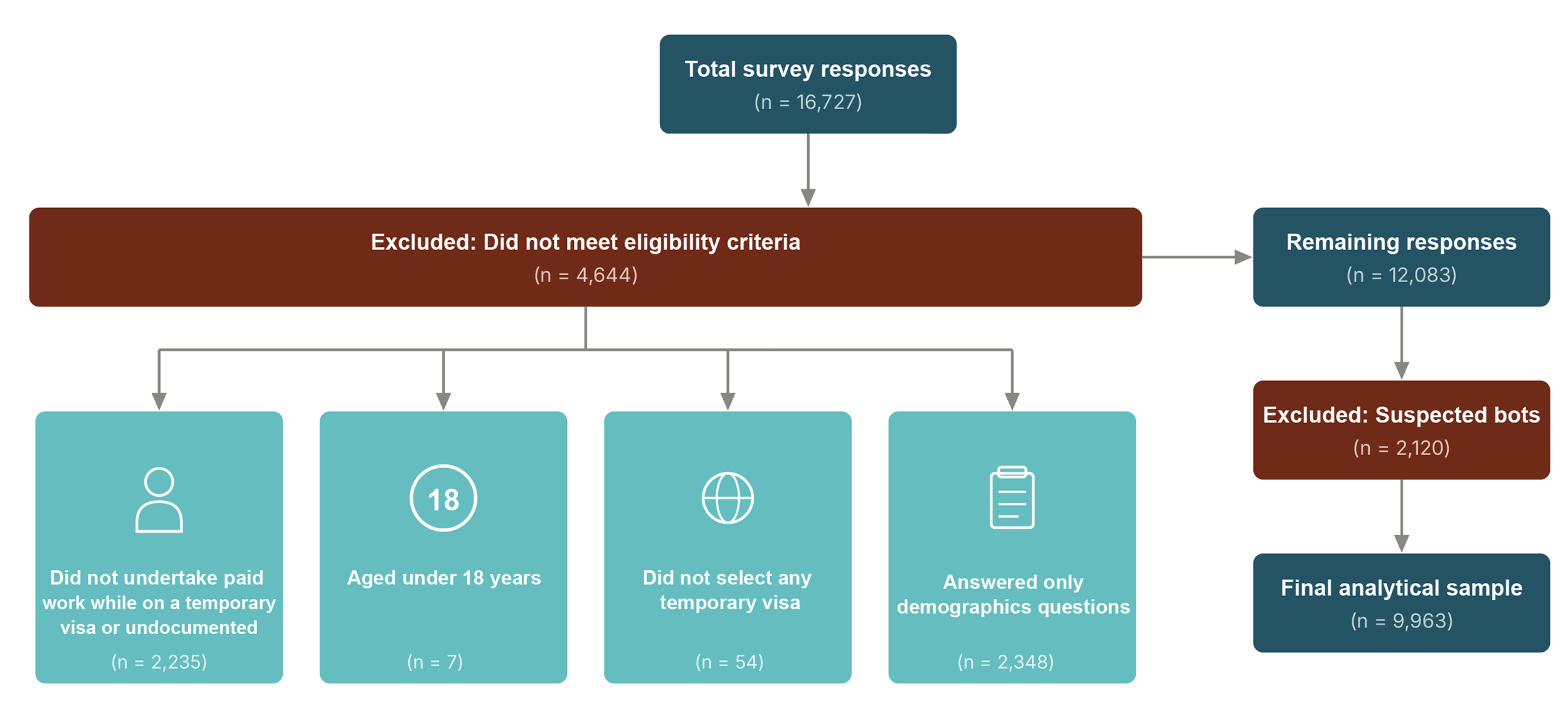
The survey yielded 9,963 valid responses.
'Thank you for asking me these questions. It makes me feel a bit better because neither my previous employers nor anyone else has asked me these before. Sometimes, I feel very lonely.'
— Male international student from Turkey, 24, in NSWSurvey development
The survey questions were designed based on MJI’s prior research, secondary literature analyses, and stakeholder consultations (see Acknowledgements) on iterative drafts of the survey instrument. The survey was tested by international student members of our Student Ambassador Program who also advised on survey dissemination strategy. The survey was translated into Arabic, Nepali, Simplified Chinese, Spanish and Tamil by accredited interpreters, and tested again in those languages.
The survey contained 76 multiple choice questions in addition to a number of follow-up questions for subsets of participants who selected a particular response. A small number of questions allowed open answers, mostly where respondents selected ‘Other’ among multiple choice options. A final open response question at the end of the survey allowed participants to provide a narrative response with any further information they wished to share. Participants were also invited to share a phone number or email address if they were open to being contacted for a follow-up interview.
The survey questions addressed features of participants’ jobs as well as a range of problems that migrants encounter at work, ranging from noncompliance with workplace laws to modern slavery and workplace injury, and how migrants respond to these.
Survey topics include:
- Participants' demographics, including visa, gender, nationality, age, location, year of arrival and, for current international students, their type of education provider and course of study;
- The nature and structure of participants' lowest paid job in 2023–24;
- Wages and entitlements received in participants' lowest paid job in 2023–24;
- Employer coercion and modern slavery indicators experienced in any job;
- Safety and injury in the workplace (including access to medical care) in all jobs;
- Problems in accommodation linked to a job or employer;
- Whether participants sought assistance with wage recovery (where underpaid) or with other problems associated with experiences of forced labour indicators (where relevant), where they went, the outcome of help-seeking, and, if they did not seek help, the barriers that prevented them from doing so; and
- Participants' knowledge of workplace rights, entitlements, and common misconceptions about their rights or culpability.
Participants were free to stop the survey at any time. As some participants exited the survey at different points before the end, the number of respondents varied between questions. In addition, some follow-up questions were only shown to participants who selected particular responses.
There were 9 questions that provided an opportunity for discursive responses as well as an open text field at the end of the survey that asked participants if they wanted to add any further observations or information. 3,656 participants provided an open text response to this final question. This report draws on numerical data from the survey as well as analysis of open responses.
The survey was a unique migrant information and empowerment tool
As with MJI’s previous surveys, the 2024 survey was designed as a learning and empowerment tool for every migrant participant. At various points in the survey participants were asked about their knowledge of aspects of their workplace rights and Australian law, and after responding were given the correct answer with a simple explanation and where to find further information. At the end of the survey participants were directed to a referral portal with information on where to get help in their state for a range of different workplace issues, and were provided with a summary of key information on all the topics addressed in the survey, and short video explainers produced by Gabrielle Marchetti at Jobwatch. These remain available on MJI’s website under the “For Migrants” tab.
Many participants expressed gratitude for the information they learned as a result of participating in the survey.
"Apparently I didn't know my rights, this survey helped a lot. Thank you so much."
— Male international student from Uzbekistan, 26, in Queensland"Through this survey, I also learned a lot of information that I didn't know before. Thank you. I hope that temporary visa holders can be protected at work."
— Female international student from China, 31, in Western Australia"Thank you for the survey. I learnt so much about my working rights in Australia."
— Female Graduate visa holder from India, 23, in VictoriaSurvey dissemination
Our dissemination strategy was developed through engagement across migrant communities, the union movement, the community sector and the international student sector. The survey was promoted to migrants through outreach by many community legal centres, unions, consulates and embassies, settlement and migrant peak bodies, student groups, hostels, service providers and community organisations (see Acknowledgements).
The survey was also promoted to migrants directly via social media, including hundreds of travel, cultural and visa-based Facebook groups and paid Facebook advertisements, as well as Instagram and LinkedIn.
We approached educational institutions across Australia to directly promote the survey to students at their institutions. Universities Australia also encouraged each of its members to promote the survey to its international students. The Australian Universities Procurement Network encouraged its members to disseminate the survey, and other peak bodies including International Education Association of Australia, Austrade, and English Australia hosted webinars for their members with information about the survey and encouraged their involvement.
We offered to provide a confidential report on the findings to any education institution where the number of student participants from that provider reached a threshold such that our findings would not identify any particular student. As a result of our own outreach and the efforts of these peak bodies, 27 education providers actively and successfully promoted the survey to their international students, with sufficiently high participation rates to obtain a tailored report on students at their institution. Other education providers also advertised the survey to their international students resulting in high participation across a wide range of institutions.
We established a Migrant Justice Institute Student Ambassador Program, comprising 40 international student representatives from StudyHubs across the country, to promote the survey to their peers. While the survey was live, we held regular briefings with this group to identify underrepresented cohorts amongst students and migrants and share effective strategies to target these groups. We also liaised with international student-focused media outlets such as Insider Guides, Koala News and the PIE News, which published other international news pieces about the survey
Data cleaning and analysis
There were 16,727 responses entered in the online version of the survey. Of these 4,644 were removed because they did not meet the eligibility criteria. A further 2,120 were excluded because we concluded they may have been bots. A full description of this process is available on our website.
Methodological limitations
The survey has a number of methodological limitations.
The online anonymous format of the survey created risks of non-genuine responses, which we were able to significantly mitigate but not entirely eliminate. Participants may have chosen random answers to complete the survey quickly in order to enter the prize draw. Those participants motivated to complete the survey quickly may have been particularly influenced by the order of possible responses (reading or selecting those at the top). Participants could also conceivably have participated more than once from different devices (though not from the same device). To mitigate these risks, the order of responses was randomised wherever possible so that if participants answered questions randomly this would not have skewed the data in any particular direction. There were no strong incentives for other participants to provide inaccurate information or to repeat the survey multiple times. We removed a small number of responses where duplicate email addresses were provided for follow-up. There was a further risk that participants may have been afraid to disclose true information for fear of repercussions. This risk was mitigated by making the survey entirely anonymous.
As is becoming increasingly common, we detected a number of bots attempting to enter data in the survey. While it was not possible to definitively determine whether certain survey responses were entered by a bot, we dedicated substantial resources over several stages of data cleaning to removing responses which may have been entered by a bot, eliminating 2,120 (see Data Cleaning and Analysis above).
A further limitation arose from methods of distribution of the survey which did not reach all migrant populations equally. Effective dissemination of the survey by many education providers led to an over-representation of international students compared with migrants on other temporary visas who could not be reached through any one cohort of providers. However, this resulted in a robust and representative cohort of over 8,000 international students. Other visa cohorts were reached through less systematic methods.
Promotion of the survey through Instagram, Facebook, WeChat, LinkedIn and Sydney Today may have contributed to over-representation of migrants who regularly use these platforms. This risk was somewhat mitigated by distribution through other channels including posters in youth hostels, emails by unions and migrant service providers and direct communication to international students by education providers (see Survey Dissemination for further detail).
Concerns about weak English-language skills were mitigated by translating the survey into Mandarin, Spanish, Nepali, Tamil and Arabic. However, the survey was not available in all languages spoken by temporary visa holders in Australia, and the survey was likely not accessible to some native speakers of other languages whose English is very weak (though it was possible for participants to use online translation software such as Google Translate). It is also possible that certain words or phrases in translated versions may have been understood differently in different languages or may not have had a culturally understood equivalent. This risk was mitigated by having the survey tested in-language by multiple native speakers and refined based on feedback.
It is likely that our survey was not taken by the most vulnerable migrant cohorts who are less networked and more difficult to reach, may have poorer English language skills and may be especially fearful of divulging experiences of exploitation or modern slavery. Our findings on experiences of forced labour indicators are almost certainly an under-representation due to this gap.
It is also possible that participation was higher among migrants who were more motivated to share information on poor workplace experiences, or to assist other migrants to avoid problems. The authors sought to limit this possibility by offering a large number of substantial prizes to create a different incentive for participation among a broader group. At the same time, it is possible that migrants experiencing financial stress were more likely than others to be motivated to complete the survey by the possibility of receiving prizes.
It should be noted that the survey included a set of questions on features of employment focused on participants’ lowest paid job in 2023-24. This is the focus of this report. There were two reasons why participants were asked about their lowest paid job. First, it was necessary to confine questions about different aspects of employment to a single job in order to analyse the extent to which those factors coincide under different employment circumstances. Second, the survey focused on participants’ lowest paid job (as opposed to any job) in order to enable analysis of the largest possible dataset on features of poorly paid jobs in which temporary migrants work, and the factors that coincide with underpayment. As a result, the survey presents participants’ worst experiences in Australia and does not capture participants’ other experiences which might have been more positive.
Finally, the findings are naturally limited to the information that could be reliably elicited from migrant workers in a survey. For instance, we did not ask respondents about the size of their employer or whether they worked for a labour hire firm. We were not confident that workers could reliably identify characteristics of their employer such as these. We were more confident that many participants would be aware of their hourly rate of pay, although it is possible that some might have rounded their hourly wage up or down if they did not recall the exact figure.
Taking these considerations into account and considering the impracticability of random sampling among temporary visa holders in Australia, the authors determined that the survey and selected distribution methods remained an effective way to access large numbers of diverse migrants to illuminate their experiences of workplace exploitation.