
PART 7 - NONCOMPLIANCE BEYOND UNDERPAYMENT
Part 7 —NONCOMPLIANCE BEYOND UNDERPAYMENT
Employers That Underpay Migrants Engage in Other Noncompliance and Cover Their Tracks
The previous section demonstrated that migrants working in casual jobs or on an ABN were more likely to be substantially underpaid compared with those in permanent/ fixed term employment. In this section we explore employer practices which either violate the Fair Work Act (such as non-payment of superannuation or breaches of record-keeping obligations) or allow employers to obfuscate underpayment (such as payments of wages in cash and making discretionary deductions from workers’ pay).
We find migrants in insecure work, and migrants who are underpaid, are more likely to experience these noncompliant and obfuscatory practices. We explore each of these practices in turn before exploring how they cluster together for workers who are more substantially underpaid. At the conclusion of this section, we observe that migrants who were a member of a trade union at some point while working in Australia were less likely to experience these employer practices and less likely to be underpaid.
No payslips or misleading payslips
Australian courts have repeatedly underscored that accurate payslips are the "bedrock" of compliance with the Fair Work Act.[i] The Fair Work Act requires employers to provide their employees with a payslip within one working day of payday, either in an electronic form or on paper.[ii] Payslips must set out the details of an employee’s pay for each pay period, including the employer’s and employee’s name, the pay period, date of payment, gross and net pay, the hourly rate (if applicable), number of hours worked, loadings and deductions. Failure to comply with these requirements breaches an employer’s record-keeping obligations. Deliberate provision of false payslips may also be an offence.[iii]
One in three casual employees received no payslip or a payslip that falsely recorded fewer hours worked
We asked participants who were employees whether, in their lowest paid job, they received payslips. Response options were: ‘yes, for all my hours’, ‘yes, but not all my hours were recorded’, or ‘no’.
Almost a quarter (24%) of all migrant employees either received no payslip or a misleading payslip that did not record all their hours. Casual employees were more than three times more likely than permanent employees to not receive payslips or receive payslips that recorded a lower number of hours than the employee worked: 23% received no payslip and 10% received a misleading payslip.
Casual employees were more than three times more likely than permanent employees to not receive payslips or receive payslips that recorded a lower number of hours.
Lack of payslips, or payslips reflecting an incorrect lower number of hours worked, were particularly bad in certain industries. This was reported by 34% of employees in hospitality (cafes and restaurants) and horticulture, 29% of employees in petrol stations, 21% of commercial cleaning employees and 71% of employees in nail salons.
"[M]ost places I've worked for didn't provide pay slips"
— Female international student from Vietnam, 19, in VictoriaMany participants provided open responses that described the way in which employers concealed underpayments by issuing payslips that falsely recorded fewer hours than the employee had worked so that the total amount of wages paid corresponded with a fictitious higher rate of pay per hour.
"In one of my casual jobs, I was paid $15/hour in reality, but on the payslips, the rate was $33/hour and it recorded less hours than the actual time I had worked."
— Female international student from Vietnam, NSWA further 40% of participants received a payslip that recorded all their hours but reflected underpaid wages. For these, we cannot know if this was a result of deliberate falsification of information on the payslip (such as non-specification of after-hours work that attracts penalty rates), or inadvertent error.
"Our working place problem is that in payslip there are no accurate dates when I worked so they give me same wage on Weekends and after 7 pm as well."
— Female international student from Korea, 23, in NSWA quarter of employees received no payslips or misleading payslips, and a large cohort received payslips reflecting underpaid wages
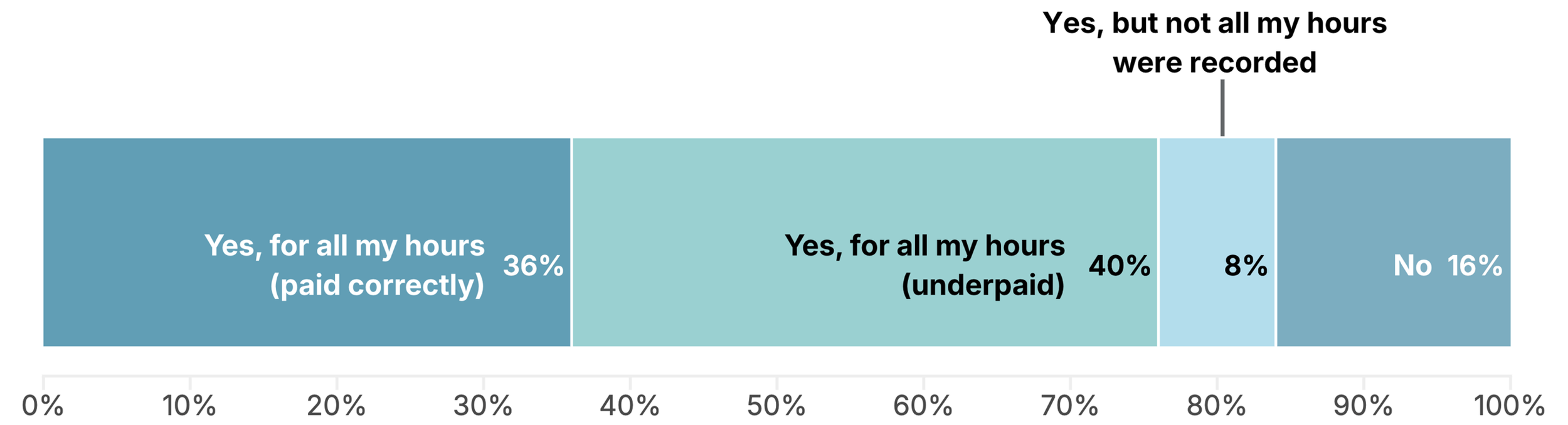
Whether participants received payslips in lowest paid job (n=4,403)
Employer provision of payslips has increased, but most payslips are either misleading or reflect underpaid wages
Employer provision of payslips appears to have increased in the last 10 years: in 2016, 44% of participants never received a payslips,[iv] while in 2024 only 16% of migrants received no payslips.[v]
In 2017, the Fair Work Act was amended to apply a ‘reverse onus’ to underpayment claims when an employer fails to meet its record-keeping or payslip obligations.[vi] If an employer fails to produce records for inspection (including payslips), the onus shifts to the employer to disprove an employee’s underpayment allegation in court.[vii] In this period, the FWO has increased its publicity and deterrence activities concerning employers’ record-keeping obligations. It appears that employers have become more aware of the possible consequences of failing to provide a payslip, and the greater possibility of detection in a FWO audit or inspection.
However, our findings suggest that a substantial proportion of employers are now using the provision of payslips to conceal underpayment – either by not recording all worker hours, or by reflecting underpaid wages that may not be apparent on the face of the payslip.
"As an international student, I got a job through a friend in a Japanese restaurant... No written contract was in place or any payslips were provided. I was given shifts a week before and I genuinely thought I was a part-time worker. The boss gave us some cash on top of bank transfer every week and I did not think too much about it and thought it was all legal as I received my wage through bank transfer... I was contacted one day by the hospitality job boss saying that the Fair work will be auditing their restaurant and was asked to lie to them that I was paid legally and provided with all my payslips which had the job title saying casual worker and the legal pay rate with less working hours than the hours I actually worked. I did tell them that due to my conscience I am unable to lie, and then the boss couple tried to contact me multiple times as they were scared of me reporting. They offered to back pay me for not reporting them. I knew they were some employees there working full-time and I did not want to make them lose their jobs, hence decided not to report them and not answer the phone calls from fair work. The boss couple promised me to increase their employees wages and pay them legally but I am not too sure how they are paying them."
Female current permanent resident from Korea, 24, in TasmaniaAbsence of a payslip was a strong indicator of underpayment
When no payslip is given, underpayment is the rule.

Likelihoods are from regressions controlling for industry, employment type, gender, age and visa.
Absence of payslips is a powerful indicator that can be used by government regulators and industry to detect likely underpayment. Underpayment was near universal among those who did not receive a payslip, often egregiously so.
In some cases, the lack of information contained in a payslip creates difficulties for regulators and businesses to detect underpayment of entitlements without further investigation. Payslips may not differentiate times of work that attract penalty rates and, as discussed above, may fraudulently omit hours worked. Nevertheless, our survey data suggests businesses and regulators could potentially detect high likelihood of underpayment in a high proportion of cases of underpaid employees either based on detecting (1) absence of a payslip, or (2) a payslip that would have revealed underpayment on its face or with minimal further inquiry because all of the employee’s hours were recorded and the employee was paid below the National Minimum Wage.
Among employee participants in our survey who were paid below their minimum entitlements:
24% did not receive a payslip;
23% of were given payslips that would have revealed wages below the National Minimum Wage.
Payment of wages in cash
It is not illegal for a worker to accept wages in cash provided they comply with taxation obligations. Nor is it illegal for an employer to pay wages in cash, provided they comply with national workplace relations system and taxation obligations. However, payment of wages in cash may be suggestive of deliberate employer noncompliance.
At the same time, records generated by electronic transfers of wage payments do not necessarily accurately reflect hourly wage rates. This is because, without compliant payslips (recording an employee’s pay, hourly rates and hours worked), an employer can dispute the number of hours worked, the rate of pay or deductions.
Nevertheless, payment of wages in cash is clearly more difficult to verify than bank transfers and enables the employer to deny even the existence of the employment relationship. This has repercussions for the worker’s ability to enforce their workplace rights beyond underpayment, such as demonstrating their entitlement to worker’s compensation if they are injured.
"the salary of my first job was only $12/hour. I know this salary is much lower than it should be. However, all other chinese student that i know did not have job with legal payment, so I have to accept that. I was trying to keep some evidence of the illegal payment. But when I get paid, I was paid by cash in an envelop. I have no evidence that I get illegal payment."
— Female international student from China, 26, in NSWDespite the dramatic post-COVID reduction of cash in the economy, many migrants are still paid wages in cash, especially casuals and ABN workers
In our 2016 survey of 4,332 participants, we found 44% were paid some or all of their wages in cash in their lowest paid job. Since then, there has been an exponential decrease of cash in the economy.[viii]
In open responses many survey participants noted the prevalence of “cash jobs” as a categorical descriptor of a particular type of exploitative last-resort job for migrants on temporary visas. Among casual employees in the current survey, 28% reported being paid at least some of their wages in cash in their lowest paid job in 2023-24.
More than one in ten casual employees were paid only in cash, compared with 1 in 25 permanent employees. Similarly, among ABN workers, 22% received at least some wages in cash (4% received all wages in cash). By comparison, only 12% of permanent employees were paid at least some wages in cash (4% received all wages in cash).
"Are employers allowed to pay very less when they opt for paying in cash ??"
— Male international student from Bhutan, in WAIn some jobs with large cohorts of workers, cash payments were especially prevalent. These include waiters/food servers (38% were paid some or all of their wages in cash; 13% were paid all wages in cash), farm workers (34% paid some or all wages in cash; 10% only paid in cash), chefs and kitchenhands (32% paid some or all wages cash; 10% only paid in cash), car wash workers (29% paid some or all wages in cash; 17% only paid in cash).
One in four migrant workers received wages in cash

Proportion of participants who received wages in cash in lowest paid job (n= 7,863)
Payment of wages in cash was a very clear indicator of underpayment
Unlike in 2016 when it was somewhat more plausible that cash was readily available to pay compliant wages, payment of wages in cash is more suspect now given the post-COVID reduction of cash in the economy.
"Most employers paying in cash pay less than $ 19 per hour in my experience."
— Male international student from India, in NSWUnsurprisingly, we find payment of wages in cash is a strong indicator of underpayment, including severe underpayment.
When wages are paid in cash, underpayment is the rule.

Likelihoods are from regressions controlling for industry, employment type, gender, age and visa
Non-payment of mandatory superannuation
Under the Super Guarantee, employers must pay super contributions based on an employee’s ordinary time earnings (OTE), including temporary visa holders. For participants who worked in 2023-24, the super contribution rates were between 10.5% and 11.5%.[ix] OTE takes into account casual loadings and penalty rates for work during the employee’s ordinary rostered hours.
The Super Guarantee applies to full-time employees, part-time employees and casual employees.[x] Since 1 January 2024, super has been established as an entitlement under the National Employment Standards, enabling most employees to take court action under the Fair Work Act to recover unpaid super.[xi] Many independent contractors who are paid mainly for their labour are entitled to the Superannuation Guarantee on the same basis as employees.[xi]
The majority of migrant employees were either not paid super, or paid an amount less than their entitlement, and non-payment of super was three times worse for casual employees
We asked participants whether they received super in their lowest paid job in 2023-24. Since we are unable to determine which ABN workers were paid mainly for their labour, we evaluate whether participants received their super entitlement only among workers who were employees.
Among employees, 27% either did not receive super, did not know whether they received super or did not know what super was. Casual employees were three times as likely as permanent employees to not be paid super or not know if they were paid super (32% vs 10%).
A further 41% received super, however their super would have underpaid because it was calculated based on underpaid earnings.
Only a third (32%) of employees reported that they received super that corresponded to their correct entitlements.
"I found out recently that my employer did not pay the amount of superannuation that was on my payslip. I recently checked my super fund and saw there is only $600 in there. In contrast my payslips state that they have contributed close to $4,000. I stopped working for this company over a year ago but still have the documentation. Unfortunately I am not sure exactly where to go to fix this."
— Male Bridging visa A holder from America, 31, in QueenslandA minority of employees received their correct super entitlements
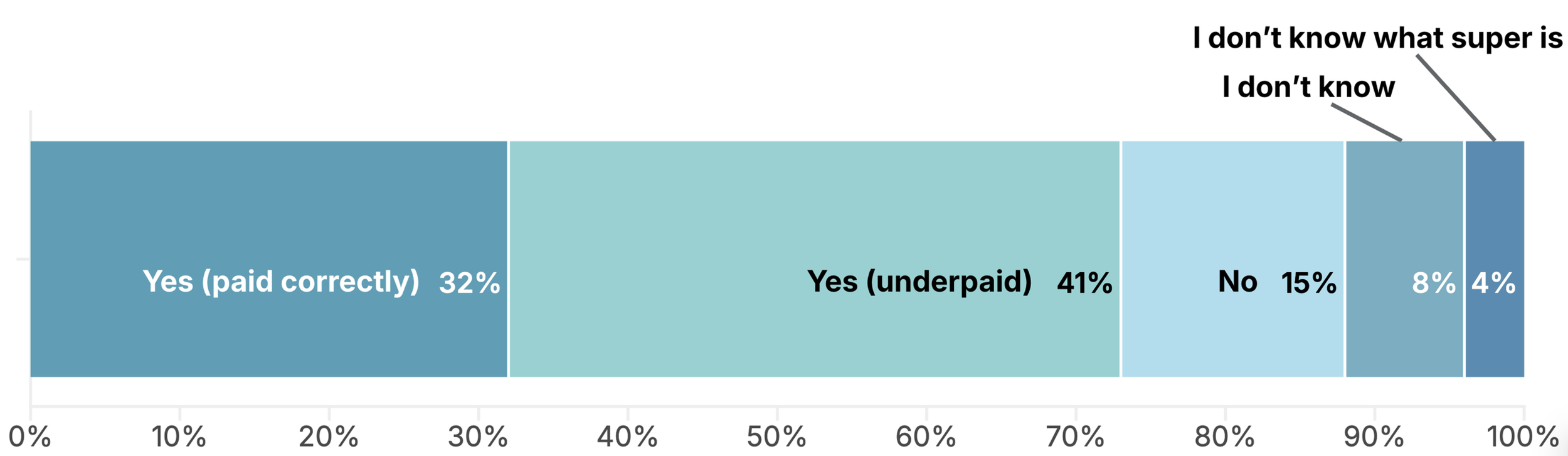
Proportion of employees who received super in lowest paid job, indicating whether those who received super had been underpaid their wages and therefore underpaid super (n=5,394)
Non-payment of super is a clear indicator of underpayment
When super isn't paid in cash, underpayment is the rule.

Likelihoods are from regressions controlling for industry, employment type, gender, age and visa (n = 7,863).
Employers that underpay migrants engage in multiple simultaneous noncompliant and obfuscatory practices: violations cluster together
This Section has explored the prevalence of workplace contraventions (including non-provision of superannuation and payslips) and other employer practices which can obfuscate underpayment (such as payment of wages in cash). In each case, migrants who were underpaid or paid below the National Minimum Wage were more likely to report these practices. And in each case, these practices were more common among casual employees.
Workplace noncompliance and job insecurity go hand in hand with these two measures of underpayment. Moreover, the greater the quantum of underpayment, the more likely the business also engaged in other contraventions and placed the worker in an insecure work arrangement.
The more egregious a migrant employee's underpayment, the greater the likelihood that the migrant is also employed as a casual, paid wages in cash, worked after hours, and was denied superannuation and payslips
Proportion of employees who received no superannuation, no/misleading payslips, casual employment status, cash payments, and after hours work among underpaid employees (by $/hour underpaid).i
i Cohorts were different for each line as they only considered participants who answered these questions. For cash (n=5,456), superannuation (n=5,377) and after-hours work (n=5,433) questions these included all employees including those who were not sure whether they were on an ABN. Payslips (n=4,393) and casual (n=4,391) questions were only asked to participants who were not on an ABN.
Employers that engaged in these noncompliant practices were also more likely to deduct sums from workers’ pay
An employer can lawfully deduct money from an employee’s pay in certain circumstances. A deduction may be lawful if the employee agrees in writing and it is mainly for the employee’s benefit.[xiii] Deductions must be recorded and the amount must appear on the employee’s payslip.[xiv] Deductions are unlawful where they benefit the employer and are unreasonable.[xv]
All participants were asked whether their employer took any amount out of their pay. They could select ‘No’ or indicate a range of different purposes for any deductions made. Some of these might have been lawful if reasonable, mainly for the worker’s benefit and deducted with the worker’s consent. These include deductions for accommodation or transport. Others (such as 'for poor performance, mistakes, or customer not paying’ or ‘equipment or uniforms’) were likely unlawful (although there are limited exceptions for lawful deductions of this kind under relevant awards or registered agreements).[xvi] 535 participant employees (10%) indicated that their employer deducted money from their wages for one or more purposes.
One in ten employees indicated their employer deducted money from their wages
Purposes for employer deduction of money from employees’ pay in lowest paid job (multiple answers permitted) (n=5,482)
Employers that deduct money from workers’ wages are substantially more likely to engage in other noncompliant behaviour
Employees who indicated that amounts had been deducted from their pay reported other noncompliance in greater numbers than among participants with no employer deductions.
Migrants who had wage deductions were twice as likely to be denied super than those who did not have wage deductions (in relative terms) (50% vs 25%)
Migrants who had wage deductions were more than twice as likely to receive no payslips or misleading payslips than those who did not have wage deductions (in relative terms) (47% vs 21%)
Migrants who had wage deductions were 26% more likely to be casual (rather than permanent) employees than those who did not have wage deductions (in relative terms) (72% vs 57%)
Migrants who had wage deductions were more than twice as likely to be paid some or all wages in cash than those who did not have wage deductions (in relative terms) (45% vs 21%)
"Last summer during my semester break, I managed to get a cash office cleaning job paying $22 an hour. Unfortunately, I lost the key to one of the sites. The person who gave me the job withheld my two weeks' pay, claiming he would deduct the cost of a new key. Even though, I decided to take legal action, I was unsure if I could file a case against him as an international student, as it was a cash job even though I worked on my semester break. But luckily, I got to fill this survey and now I am clear that I can take legal actions against him. Thank you so much for this information!"
— Male international student from Nepal, 22, in NSWDelayed payments, unpaid ‘trials’ and unpaid ‘training’
Though we did not address these issues in the survey questions, many survey participants provided open responses documenting ways in which employers cause migrants to work for no pay. Numerous participants described unpaid 'trial' periods lasting several days or even weeks.
"Having to do with lower than minimum wage has been a normalised norm especially if you're on an international student on a student visa. Most employers especially expect you to do more than what is expected in order for you to even be able to hold your job. When I first landed in Australia I was asked to work for a week without any wages as a 'trial' to prove to my employer that I could perform the given task. Losing a week worth of wages is not a small amount when you have bills to pay."
— Female international student visa from India, in NSWParticipants also referred to extended periods in which the employer did not pay them on the basis this work was 'training'.
"When I queried back to the owner about my salary for the days that I worked, she replied that there was a misunderstanding on my end as it was three days of unpaid training. I defended myself by saying that this was not what I had been told when I succeeded in the trial one week before, and that in any case, even under training, there should be a minimum wage. I was rejected with a simple "no" and was told to go to Fairwork if I would like to; that the wait time would be so long that I would get nothing from there also."
— Male international student from Mauritius, 34, in WAOthers noted that employers charge migrant workers fees to undertake unpaid 'internships' with a an expectation of further work that never materialises.
"There are Companies that hire only and only interns, keep them on a 3month period promising them job if they turn out resourceful but at the end of the 3 month contract they will simply ask the intern to leave be replaced by another intern to do their job or be asked to work for free being fooled to be doing it for the sake of experience. Whats worse is individuals pay around 2200 dollars to get hired into such companies for the sake of experience. They pay them with an expectation to get an entry point into their industry but are left without being actually employed."
— International student from India, 22, in VictoriaMany participants noted their employer delayed their salary payments by weeks or even months, causing substantial financial distress and stress for the migrant.
"The employer sometimes does not pay the salary on time as we discussed at the beginning or as in the contract. For example in my case, my boss did not pay salary weekly as written in the payslip and contract. He even ignored my message until I let him know I would contact Fair Work to help me. He always delayed the payment for one month or two months which significantly impact my life."
— Female international student from Vietnam, in SA"Previous work place the person who hired us gave job for both me and my husband. but he only paid for only one person. But we both worked there. It was the time we just arrived Australia. We were not familiar with our rights and that was the first job we did. We found it with great effort. So we couldn't stop it because we have to cover our living expenses. Later we thought we should stop that job because we two people engaged the job but getting paid for only one. So we told the supervisor and quit the job, he was really angry we had arguments and he did not pay for 5 days. That means he paid our salary after reducing 5days. He told that because we quit the job he has to train someone again and that will cost for him so deducted 5days salary. He was a sub cleaning contractor..."
Female permanent resident from Korea, 24, in TasmaniaReferences
[i] Fair Work Ombudsman v Quickpoint Pty Ltd [2022] FedCFamC2G 991 [141]; Fair Work Ombudsman v Dosanjh [2016] FCCA 923 [46] per Altobelli J; Fair Work Ombudsman v ACN 052 182 180 Pty Ltd & Anor [2013] FCCA 688, [20]; Fair Work Ombudsman v Soleimani & Anor [2014] CA 2380 at [55].
[ii] Fair Work Act 2009 (Cth) s 536. See also s 557C and Part 3-6 Div 3 of Fair Work Regulations 2009 (Cth).
[iii] Under the Fair Work Act 2009 (Cth) s 536(3) an employer must not 'give a pay slip for the purposes of this section that the employer knows is false or misleading.' This is a civil remedy provision. But deliberately providing a false payslip may also satisfy other criminal offences i.e. false or misleading documents under the Crimes Act 1900 (NSW) s 307C and similar offences under other state legislation.
[iv] Bassina Farbenblum and Laurie Berg, 'Wage theft in Australia' (2017) 23(3) Australian Journal of Human Rights 310, 314.
[v] Both figures exclude skilled visa holders from the relevant pool of migrant workers.
[vi] Fair Work Amendment (Protecting Vulnerable Workers) Act 2017 (Cth).
[vii] Fair Work Act 2009 (Cth) s 557C.
[viii] Mary-Alice Doyle, Chay Fisher, Ed Tellez and Anirudh Yadav, How Australians Pay: Evidence from the 2016 Consumer Payments Survey (Research Discussion Paper, 2016) 17; Jack Mulqueeney and Tanya Livermore, Cash Use and Attitudes in Australia (Report, June 2023) 30-31.
[ix] The proportions were 10.5% up to 30 June 2023, 11% up to 30 June 2024 and 11.5% from 1 July 2024.
[x] Fair Work Act 2009 (Cth) s 116B; Superannuation Guarantee (Administration) Act 1992 (Cth) s 12, 16; Fair Work Ombudsman, 'Tax and superannuation' (Webpage) https://www.fairwork.gov.au/pay-and-wages/tax-and-superannuation#super-guarantee.
[xi] Fair Work Legislation Amendment (Protecting Worker Entitlements) Act 2023 (Cth) Sch 3 s 1; Fair Work Act 2009 (Cth) s 61(2)(ha).
[xii] Superannuation Guarantee (Administration) Act 1992 (Cth) s 12(3).
[xiii] Fair Work Act 2009 (Cth) s 324(1).
[xiv] Fair Work Regulations 2009 (Cth) Reg 3.46(2).
[xv] Fair Work Act 2009 (Cth) s 324(1A), 326.
[xvi] Hospitality Industry (General) Award 2020 (Cth) Cl 36.