
PART 5 - WAGES AND EMPLOYMENT STRUCTURE
Part 5 — WAGES AND EMPLOYMENT STRUCTURE
Many Australian Businesses Abuse Their Leverage Over Migrant Casual and ABN Workers to Engage in Severe Wage Theft
This section considers the effect of insecure employment status on the likelihood and extent of underpayment.
Insecure work drives underpayment
As discussed later in this section, we found that the majority of participants who worked as casual employees were paid well below their individual minimum entitlements. It might have been hypothesised that because employment as a casual was more common among certain cohorts (see discussion in the next section), those distinguishing features were the real drivers of the underpayment.
However, we found that even when factors like industry, visa and nationality were held constant, participants in casual employment were still 50-60% more likely to be underpaid their entitlements than workers in permanent employment.[i]
Casual employment was a substantial independent driver of underpayment regardless of the participant’s industry, nationality or visa.
"Being a casual worker is like walking on egg shells. Not knowing when they will decide that they no longer need you"
— Male international student from Zimbabwe, in NSWCasual and ABN workers were twice as likely as permanent employees to be paid beneath the National Minimum Wage floor
It appears that a substantial number of employers are engaging migrants through these less visible arrangements in order to avoid meeting even the National Minimum Wage floor for these workers.
Migrants in casual jobs or on an ABN were paid fewer dollars per hour in absolute terms than migrants in permanent employment. 37% of casual employees and 43% of ABN workers were not even paid the base National Minimum Wage.
John Howe and Tom Dillion have also observed this pattern in the context of insecure employment of young Australian workers. They note that, ‘ it is unsurprising that contractors and non-permanent employees indicated high levels of exploitation within their lowest paid jobs; firms’ detachment from the conventional employment model is motivated substantially — if not primarily — by efforts to circumvent the suite of rights afforded to permanent employees under workplace legislation’.[ii]
Substantial numbers of casuals and misclassified ABN workers were paid below the National Minimum Wage
Wages received in lowest paid job by permanent employees, casual employees and ABN workers in industries in which many were likely misclassifiedi (n=6,772)
i As discussed above in Most migrant work on an ABN is likely misclassification of employees as contractors, we considered that 21% of participants were likely misclassified employees because they worked on an ABN in industries in which independent contracting is not common (including hospitality, retail, commercial cleaning and factory/warehouse workers). Others (14% of participants) worked on an ABN in jobs where they likely met the legal criteria for an independent contractor running their own business (including delivery riders, rideshare drivers, and professional, administrative and construction workers).
"Where I work, the salary is no more than $21, the highest is $20.50. I have told my family about this, but they said that we are not Australian citizens, so it is normal to be bullied."
— Female international student from China, 20, in South AustraliaCasual employees
When looking at the dollars paid per hour to casual workers, it appears that many employers of these workers are simply making up a wage that does not bear any relationship to minimum wages under the Fair Work Act.
The minimum entitlement for a casual worker on 1 July 2023 was $29.04 per hour (National Minimum Wage plus 25%, not taking into account Award rates or penalty rates for work on nights and weekends).[iii]
Wage distribution amongst casual employees
73%
were paid below the casual minimum wage
Casual minimum on 1 July 2023: $29.04/hr
42%
earned $20–$25 per hour
18%
earned less than $20 per hour
Full distribution shown in the chart below.
Many casual employees were paid wages that bore no relationship to the Fair Work Act, and far beneath the casual minimum wage
Participants’ hourly wage in their lowest paid job, for casual employees (n=2,596)
ABN workers: independent contractors and misclassified employees
The wage rate pattern for all workers on an ABN was remarkably similar to that for survey participants who were casual employees (with almost no relationship to Fair Work Act casual minimum wages).
The overwhelming majority were earning far less than they would have earned as employees under the Fair Work Act.
Wage distribution amongst ABN workers
79%
were paid below the casual minimum wage
Casual minimum on 1 July 2023: $29.04/hr
47%
earned $20–$25 per hour
22%
earned less than $20 per hour
Full distribution shown in the chart below.
Businesses that engaged workers on an ABN paid far less than they would have been required to pay an employee under the Fair Work Act, and well beneath the casual minimum wage
Participants’ hourly wage in their lowest paid job, for ABN workers (n=2,363)
We considered the wages earned by workers on an ABN against the minimum wage for a casual employee in a similar job, because most workers on an ABN were likely misclassified (see previous section) and lawfully entitled to that wage. For the others who were lawful contractors, the casual minimum is still an appropriate yardstick because they should reasonably expect to earn at least these basic minimum hourly rates that compensate for the lack of predictable work and paid leave.
Workers on an ABN had different wage profiles when comparing those who were likely misclassified (i.e. working in industries in which genuine independent contracting is unusual) with those in industries in which lawful independent contracting is more common.
Those who were likely misclassified looked more similar to casual employees but were substantially less likely to be paid the casual minimum than casual employees (16% vs 27%) and more likely to be paid below National Minimum Wage than casual employees (41% vs 37%). Among likely misclassified employees, 43% were at or above minimum wage and below the casual minimum (compared with 36% of casuals). A likely explanation is that when employers of this large cohort engage these workers on an ABN, they make the arrangement appear reasonable to the worker by paying above minimum wage, which some may consider market rate because they do not take into account the casual loading (and penalty rates) that would apply as an employee.
Delivery and rideshare workers
Especially low hourly wage rates were widespread in gig work jobs, such as delivery riders and rideshare/taxi drivers. As minimum employment standards typically do not apply in these jobs, hourly wage rates can vary wildly.
Among the 190 participants who worked as a delivery rider in their lowest paid job, 87% were on an ABN, as were 88% of the 227 rideshare and taxi drivers. Among these workers, 59% earned less than $20/hour. In contrast, among the smaller cohort of workers who were engaged as employees, 42% received less than $20/hour.
It should be noted that this was their 'lowest pay per hour' in this job rather than their average hourly wage, though it is unclear how much more they were earning across all of the hours they were working, or what proportion of this wage was needed to cover expenses related to their vehicle and equipment. 92% of these workers worked nights and weekends.
"As an immigrant, finding a job can be quite challenging initially. Therefore, I often resort to working for UberEats and DoorDash. However, there is no minimum wage for these gigs, and sometimes I earn only $10 to $15 per hour because we aren't paid for the time spent waiting."
— Male international student, 27, in WAMigrants who worked nights or weekends were more likely to be paid below National Minimum Wage, especially those who were misclassified ABN workers
Among employees who worked nights and weekends, 29% were never paid more for those hours and 16% were paid more for some but not all of those hours. Because work after hours attracts penalty rates under most awards, many migrants working nights and weekends who were paid the same as their ordinary business hours rate would have been substantially underpaid.
The impact of working nights and weekends goes beyond non-receipt of penalty rate entitlements for those hours.
Employees who worked nights and weekends were over 50% more likely to be paid below the National Minimum Wage than those who did not work nights and weekends.
Over a third (34%) of employees who worked nights and weekends were paid below the National Minimum Wage, compared with 21% who did not work nights and weekends.
Independent contractors are not entitled to penalty rates (or minimum wages). This is a key driver of sham contracting by employers seeking to avoid responsibilities to pay penalty rates for after-hours work.
Among ABN workers who were likely misclassified and may have been sham contracted, 90% worked on nights and weekends and 42% did not even receive the National Minimum Wage.
"My employee pays other staff weekend higher rate but not for me. I cannot say that because I might lose my job."
— Female international student from Mongolia, 30, in NSWUnderpayment of individual minimum entitlements is systemic and extreme for those working as casuals or on an ABN
In addition to evaluating participants’ wages against statutory minimums, we also evaluated wages against each participant’s individual minimum entitlements based on: the lowest level under the award for their job (or the National Minimum Wage if no award applied); youth rates under the award for those aged 18-21; penalty rates under the award for those who worked at night or on weekends (using the lowest penalty rate); and application of a 25% casual loading for those not entitled to paid annual and sick leave.
Roughly the same proportion of permanent and fixed-term, casual and ABN workers were underpaid between $1 and $5 per hour (24-25%). However, at greater levels of underpayment, casual and ABN workers were vastly more likely to be underpaid.
Casual and ABN workers were more than 5 times as likely as permanent employees to be underpaid by greater than $5 per hour, and 10 times more likely to be underpaid by greater than $10 per hour
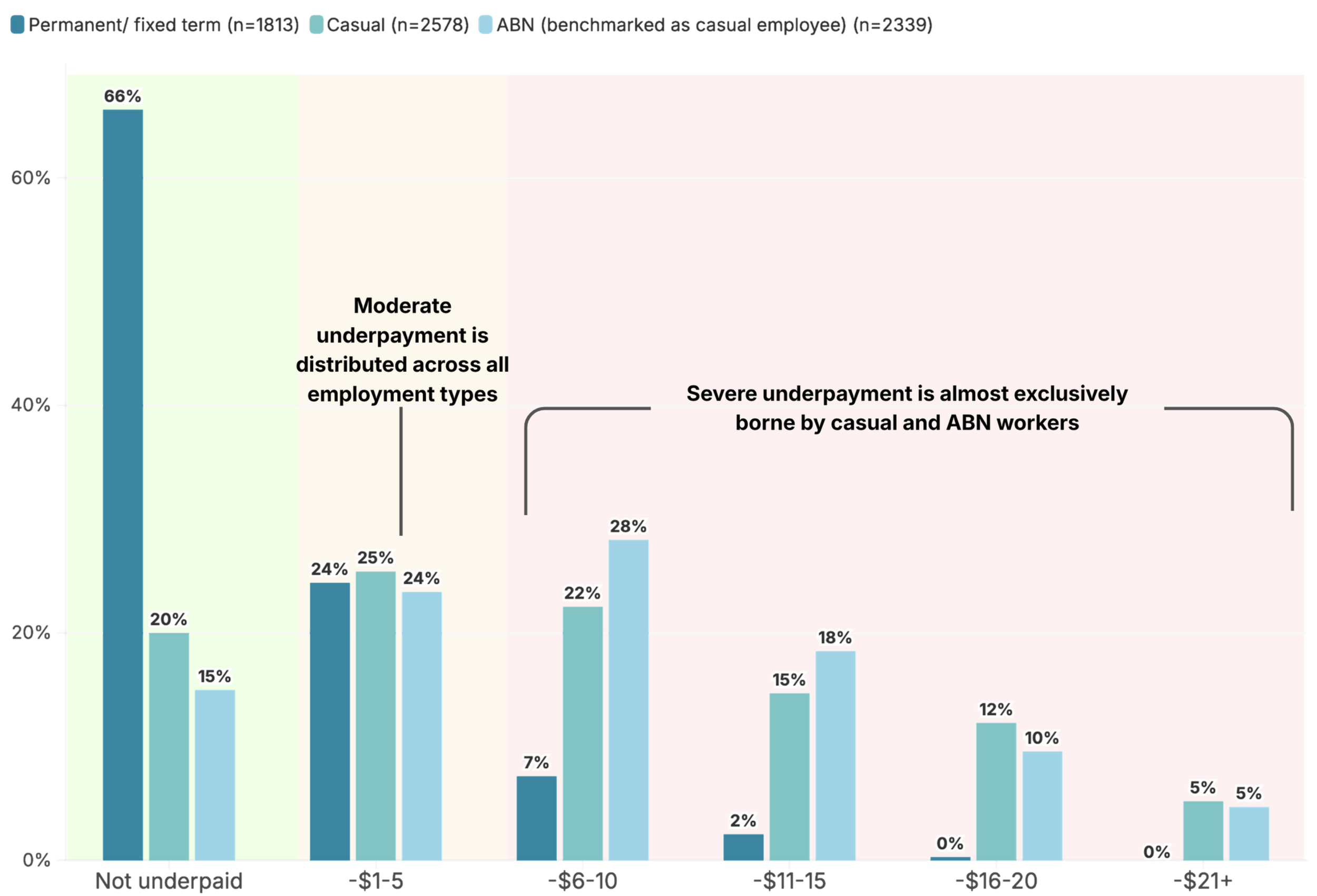
Dollars per hour participant was underpaid, based on individual entitlements in lowest paid job, as a proportion of all participants in that employment structure (ABN workers benchmarked to casual employee entitlements) (n=6,730)
Insecure work, deeper underpayment.
Migrants in casual or ABN work were more than twice as likely to be paid below their legal entitlement as those in permanent employment — and when they were underpaid, the gap was more than twice as large.
 “Below legal entitlement” combines award rate, 25% casual loading where applicable, youth rates and minimum penalty rates.
ABN workers: independent contractors and misclassified employees
The overwhelming majority of ABN workers were paid less than the minimum entitlements they would have had under the Fair Work Act if they were classified as a casual employee.
89% of likely misclassified workers were paid less than the minimum entitlements they would have had under the Fair Work Act as a casual employee. A third (33%) of ABN workers were paid more than $10 per hour beneath the minimum entitlements of a casual employee.
Casual employees
The overwhelming majority of casual employees were paid substantially below their individual minimum entitlements:
80% of casual employees were paid below their minimum entitlements;
More than half (54%) were underpaid by at least $6 per hour and a third (32%) were underpaid by more than $10 per hour; and
One in six (17%) were underpaid by more than $15 per hour.
In reality, it is unlikely that the workers paid those rates had been given a formal employment contract as a casual employee. Most likely simply had an informal agreement that they would work certain hours at a certain rate, determined each week verbally or via text message, with no reference to Fair Work Act classification or entitlements.
Many participants would not have known that they were a casual employee, and that this meant they were entitled to a 25% loading on minimum wages. Indeed, when asked ‘What is the legal minimum hourly wage for a casual worker?’, two thirds (66%) of those who had been a casual employee in their lowest paid job could not identify the minimum as at least $29 per hour. One third of participants (32%) who had been a casual worker believed the legal minimum for a casual worker was $24 or $25 - the National Minimum Wage at the time of the survey. In contrast, 80% of casual worker participants knew the standard minimum wage was $23 or above.
"I agreed with my boss on the minimum wage and working part-time. In fact, my boss didn't know that the minimum wage had increased to 23, and still paid me 22/hour. My boss told me that I was working part-time, but in fact, he only asked me to come to work when he was busy and needed help. Sometimes I didn't go to work for two weeks."
— Male international student from China, 28, in NSWReferences
[i] All regression analyses in this report were conducted using a robust Poisson model to estimate the impact of certain characteristics on the likelihood of underpayment. Our outcome variable is a binary: whether someone has been underpaid or not. We run the regression with different definitions of underpayment, including: whether respondents were paid below their own entitlements (taking into account their entitlement to the statutory minimum, casual entitlements, award entitlements and penalty rates); and whether respondents were paid below the statutory minimum ($23.23). We round down the minimum and class anyone who earns $1 less than that as underpaid, i.e. $22 for the statutory minimum of $23.23.
[ii] John Howe and Tom Dillon, Underpaid and Overlooked: The Wage Crisis Facing Young Workers in Australia — Final Report of the Fair Day's Work Project (Report, July 2025) 18.
[iii] Order of Justice Hatcher, President, Vice President Catanzariti, Vice President Ashbury, Deputy President Hampton, Ms Labine-Romain, Professor Baird, Mr Cully in Annual Wage Review 2022-23 (Fair Work Commission, PR762107, 20 June 2023). This does not take youth rates into account, however those rates were taken into account when calculating each participant's individual minimum entitlements. Only 5% of participants were under 20 years old.