
PART 4 - EMPLOYMENT STRUCTURE
Part 4 — EMPLOYMENT STRUCTURE
Businesses Engage Most Migrants in Insecure Work Arrangements that Give Employers Overwhelming Leverage
This section reports on the structure of participants’ employment in their lowest paid job between 1 January 2023 and 31 August 2024. It compares migrants’ employment structure with the broader Australian labour force and considers the implications of insecure work arrangements for migrants’ vulnerability to workplace exploitation.
Most work in the general Australian labour force occurs in permanent and fixed-term employment, but the vast majority of migrants in our survey worked on an ABN or as a casual employee
Permanent employment is the norm across the labour market in Australia. ABS data shows that three quarters (74%) of the Australian workforce were permanent or fixed-term employees at the time of the survey (August 2024).[i]
Under the Fair Work Act, permanent employees and those on fixed-term contracts have a firm advance commitment to ongoing employment and can usually expect to work regular hours each week – either part-time or full-time.[ii] They are entitled to at least four weeks paid annual leave, and two weeks paid sick or carer’s leave and must give and receive notice to end the employment.[iii] In this report, we refer to permanent and fixed term employment as ‘permanent employment’.
Only 27% of survey participants were permanent employees. The remainder were in insecure work arrangements as casual employees or on an ABN.
Three quarters of migrant workers were engaged in insecure work arrangements

Participants’ work arrangements (n=6,778)
Casual employees have no advance commitment to ongoing work, no predictability of future work, and no entitlement to paid sick or annual leave. In recognition of these diminished entitlements and the insecurity of their position, casual employees are entitled to a casual loading or specific casual pay rate under an award.
At the time of the survey, 18% of the Australian labour market was in casual employment.[iv] However, casualisation was higher among employees who did not work full-time hours: 49% of employees who worked part-time hours were engaged as casuals' based on information from ABS (August 2024).[v]
We are unable to distinguish full-time and part-time employees in our survey cohort. However, within the full cohort of migrant employees in our survey (including those working full-time), 59% were employed as casuals - a higher proportion than in the Australian part-time workforce.
Within our survey cohort a slightly larger proportion of women than men were casual employees in their lowest paid job (39% vs 37%), while 37% of men worked on an ABN compared with 33% of women. The proportions of casual workers and ABN workers in urban, regional and other regional/remote areas were similar.
A higher proportion of migrant employee participants in the survey were employed as casuals, compared with the proportion of part-time employees in the Australian labour market who are employed as casuals

Proportion of employees who are casual versus permanent employees, comparing survey participants (n= 4,415) with ABS data on part-time employees in the Australian labour market.
Over a third of migrants in our survey were engaged on an ABN – exponentially higher than the prevalence of ABN work in the Australian labour market
ABS data indicates that 7.5% of all workers in Australia worked on an ABN at the time of the survey (August 2024).[vi] Industries where the use of independent contractors was most common were construction (24% of people in construction) and administrative and support services (19%).[vii] By comparison, 35% of migrant workers in our survey were engaged on an ABN.
"Many times your boss wants you to trade with them using ABN, so that you become a business entity instead of a legal TFN employee … Because if they need to pay more money by time, they prefer you to trade with ABN so as not to pay pension."
— Female international student from China, 22, in VictoriaABN work among survey participants was over 4 times more common than in the Australian labour market
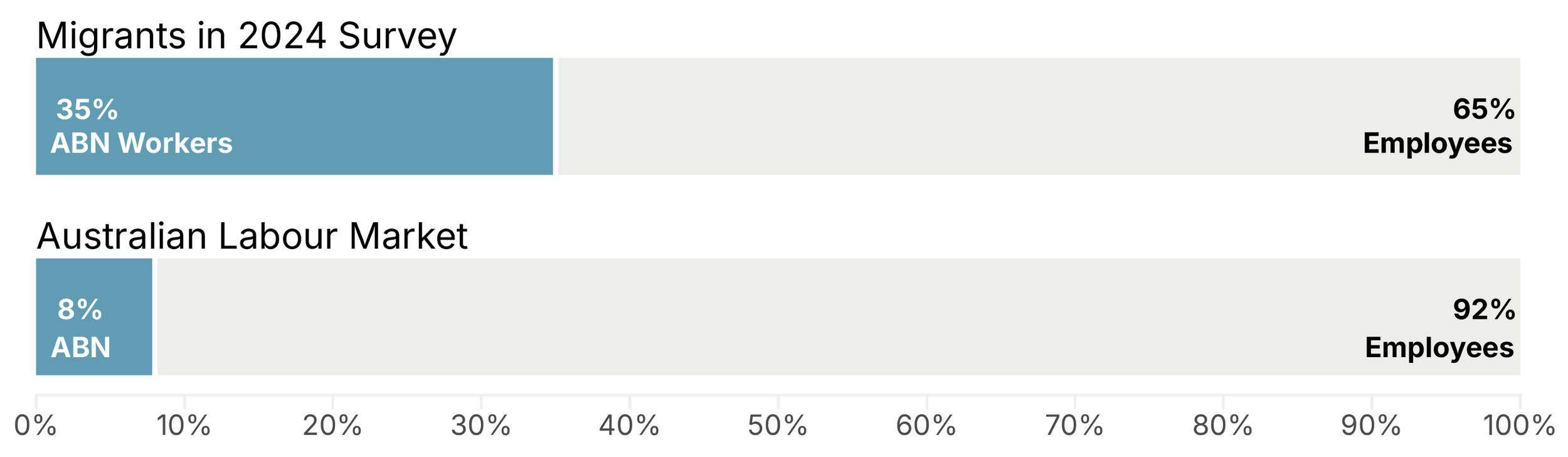
Proportion of workers on an ABN, comparing survey participants (n= 6,778) with ABS data.
Legal framework governing work on an ABN
ABNs are used by independent contractors who perform work or provide services for others without having the legal status of an employee. Independent contractors are engaged under a contract for services (a commercial contract), negotiate their own fees and working arrangements and frequently work for more than one client at a time. By contrast, employees are engaged under a contract of service (an employment contract), performing work under an employer's control.
How protections differ for employees and contractors
Employees are entitled to minimum protections under the Fair Work Act and relevant industrial awards. These include minimum wages, paid leave or a casual loading, and penalty rates for overtime or work on nights, weekends or public holidays. Independent contractors are not entitled to a minimum wage or pay rate. They may also have reduced entitlements to workers compensation and superannuation.
How to distinguish an employee from a contractor
In law, several factors must be considered together, including: the amount of control over how work is performed; financial responsibility and risk; who supplies the tools and equipment; ability to delegate or subcontract work; hours of work; and expectation of work continuing.
Prior to 26 August 2024, in cases where there was a written agreement between the parties, the critical point at which to consider these factors was at the 'start of relationship', based on the terms of that agreement.i From 26 August 2024, the Labor government's Closing the Loopholes Act re-instated the previous approach which considers the factors above in light of the 'whole of relationship' between the parties.ii Rather than a narrow focus on the agreement between the parties, the factors are now considered in light of 'the real substance, practical reality and true nature of the relationship' and 'all parts of the relationship between the parties, including the terms of the contract and how the contract is performed in practice'.iii
'Misclassification' and 'sham contracting'
Misclassification occurs when a business treats a worker as an independent contractor, including by asking them to provide an ABN and submit invoices for their work, even though the agreed working arrangements indicate that the worker is an employee.iv A worker on an ABN who is a misclassified employee is entitled to the same protections under the FW Act as all other employees, regardless of the state of mind of the employer. However, in practice, in order to assert their rights as an employee, the ABN worker must first prove that they are misclassified.
Sham contracting occurs where an employer unlawfully misrepresents to the employee that the employment relationship is an independent contracting arrangement when the employer does not reasonably believe this.v Businesses engage in sham contracting to avoid paying legal entitlements such as minimum wages, super, leave and workers' compensation. The Labor government's Closing the Loopholes Act narrowed the defence for an employer from a 'recklessness' test to a 'reasonableness' test.vi To defend a sham contracting claim, an employer must now prove they reasonably believed they properly engaged the worker as a contractor.
Basic protections for contractors who are not misclassified but are vulnerable
In 2024, the Labor government introduced a new scheme for 'regulated workers',vii defined as contractors who are 'employee-like workers' doing 'digital platform work' in the road transport industry. These reforms gave the Fair Work Commission jurisdiction to make minimum standards orders for these Independent contractors, including protections against unfair deactivation (similar to dismissal) and minimum wage standards. This scheme was not yet in place at the time of the survey.
i Fair Work Ombudsman, 'Independent Contractors' Fair Work Ombudsman (Web page) https://www.fairwork.gov.au/find-help-for/independent-contractors#difference-between-contractors-and-employees. And see CFMMEU v Personnel Contracting Pty Ltd [2022] HCA 1 and ZG Operations Australia Pty Ltd v Jamsek [2022] HCA 2.
ii Fair Work Act 2009 (Cth) s 15AA; Fair Work Legislation Amendment (Closing Loopholes No. 2) Bill 2024 (Cth) Sch 1 s 237; Fair Work Ombudsman, 'Whole of relationship test' Fair Work Ombudsman (Webpage) https://www.fairwork.gov.au/find-help-for/independent-contractors/whole-of-relationship-test.
iii Ibid.
iv Fair Work Ombudsman, 'I think I could be an employee not a contractor' Fair Work Ombudsman (Webpage) https://www.fairwork.gov.au/workplace-problems/common-workplace-problems/i-think-i-could-be-an-employee-not-a-contractor.
v Fair Work Act 2009 (Cth) s 357(1).
vi Ibid s 357(2)-(3).
vii Ibid Part 1-2 Division 3A.
Most migrants on an ABN are likely misclassified employees who are denied their Fair Work Act entitlements
One in every five survey participants (21%) worked on an ABN in an industry in which independent contracting is not common.[viii] For many of these workers, it is more likely that they were misclassified employees who are in fact entitled to protections under the Fair Work Act.[ix]
This includes 760 workers in hospitality, 206 in retail, 208 in commercial cleaning, 51 factory/warehouse workers, 43 health care workers, 42 aged care workers, 39 childcare centre workers, 27 farm workers, 17 car wash workers, 16 nail salon workers, 15 petrol station attendants, 14 meat workers and others. For the remainder of this report we refer to this cohort as ‘likely misclassified’ ABN workers.
"There was this one restaurant. It is very well known... They use to pay some employees on ABN and a lot of times they wouldn't pay the amount we are owed. When I told them I want to leave they threatened me. Saying things like in Australia you can't leave without a 3 week notice and they can complain to fair work about me and have me prosecuted. I was going through a lot at that time. My grandma back in India was diagnosed with cancer. I was struggling"
— Female international student, 24, in NSWAround one in seven participants (14%) worked on an ABN in jobs in which a larger proportion would likely have met the legal criteria for an independent contractor running their own business (see Figure 9).[x] These include 365 delivery riders, rideshare and taxi drivers, 202 professional or technical services workers, 85 administration workers, 25 gig workers, 79 cleaners in a private home, 53 construction workers, and smaller numbers of NDIS care workers, nannies/ babysitters, hairdressers, massage workers, and others.
Across most industries migrants were primarily engaged as casuals or on ABNs and many workers on ABNs were in industries in which they were likely misclassified employees
Structure of employment among participants in their lowest paid job (n=6,765)
After-hours work is ubiquitous for migrant workers regardless of the structure of the work relationship
Most survey participants (83%) worked at night or on a weekend in their lowest paid job. There is no recent ABS data on trends in the broader Australian labour market,[xi] however, the NSW Government recently reported that in 2024 night-time workers comprised 21% of the NSW workforce.[xii]
However the data is cut, between roughly 80% and 85% of migrant workers in their lowest-paid job worked nights or weekends.
The pattern holds across employment type and gender, and sits well above the NSW workforce baseline. By industry, between 70% and 90% of MJI participants worked nights or weekends in every industry except childcare centres and professional/administration roles.
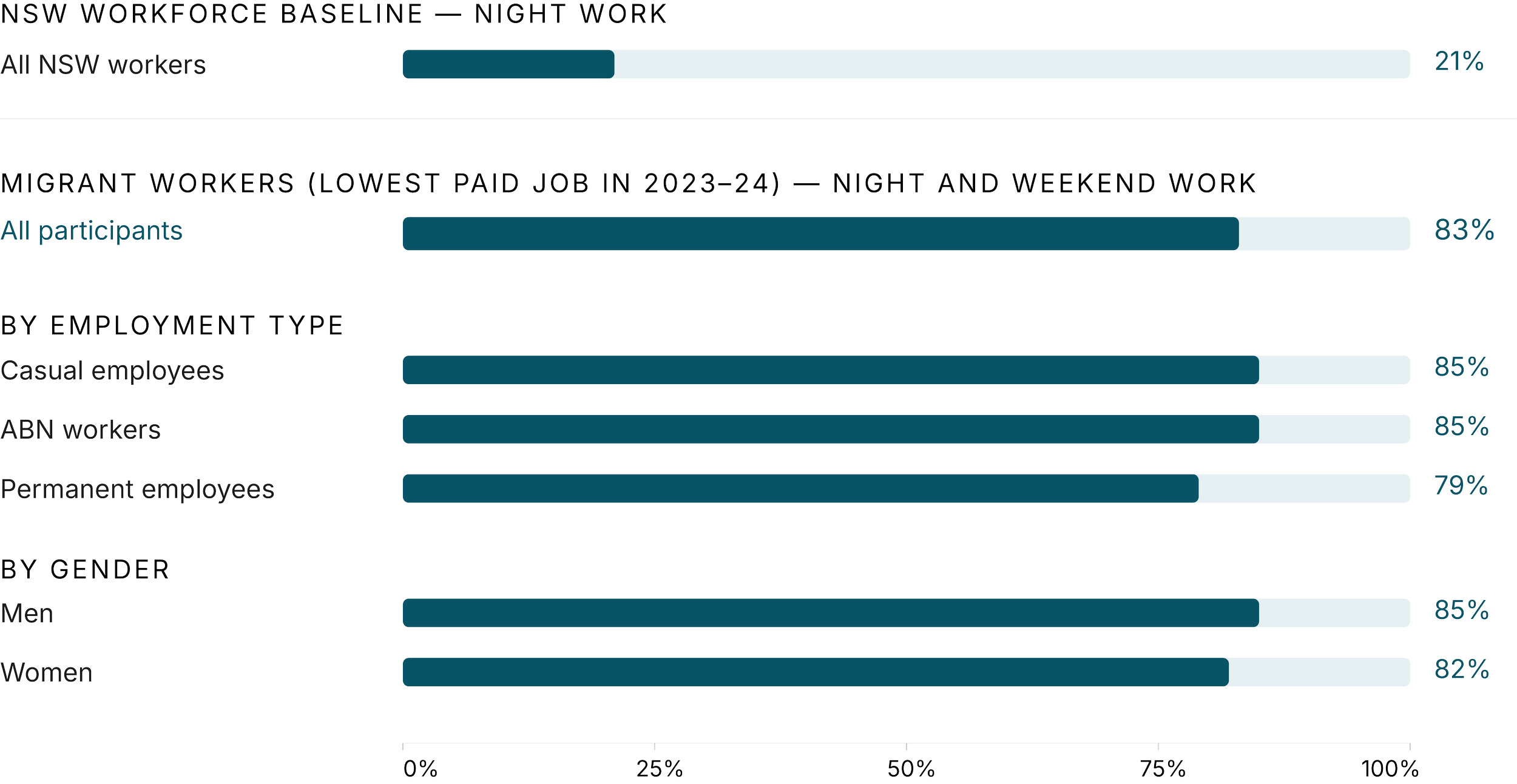
Night and weekend work may suit some international students who attend classes during the day. However, the reduced visibility of work on nights and weekends also makes those workplaces less physically safe. Fewer other workers may be present, supervision may be more limited, and there may be less visibility by the public. Commutes to and from work often take longer on public transport, and returning home alone at night on foot or on public transport late at night can pose particular safety risks for women. More than four in five female participants (82%) worked nights and weekends, almost the same figure as for men (85%).
Working outside business hours, and reduced visibility of the migrant’s work, also creates challenges for the worker to prove their hours worked. As discussed in the next section, after hours work is independently associated with increased risk of underpayment.
"It is difficult to avoid being exploited on a temporary visa. This is the truth."
— Female international from China, 40, in TasmaniaReferences
[i] Australian Bureau of Statistics, 'Working Arrangements' Australian Bureau of Statistics (Web page, August 2024) https://www.abs.gov.au/statistics/labour/earnings-and-working-conditions/working-arrangements/aug-2024#independent-contractors.
[ii] Fair Work Act 2009 (Cth) s 15A.
[iii] Ibid s 87, 96, 117-118.
[iv] The Characteristics of Employment (COE) survey was conducted throughout Australia in August 2024 as a supplement to the monthly Labour Force Survey (LFS). As of August 2024 (the time of our survey): 22% of employees did not have paid leave entitlements (18% of all workers); for employees who work part-time in their main job (i.e. fewer than 35 hours/week), 49% did not have paid leave entitlements; paid leave entitlements were more common among higher paid workers. In August 2024, 92% of employees who earned the median wage of $1,396 per week or more were entitled to either paid sick leave or paid holiday leave, or both. For employees in the lowest 25 per cent of earners (less than $899 per week), 45% had paid sick leave or paid holiday leave entitlements. Australian Bureau of Statistics, 'Characteristics of Employment, Australia methodology' Australian Bureau of Statistics (Web page, August 2024) https://www.abs.gov.au/methodologies/characteristics-employment-australia-methodology/aug-2024#introduction; Australian Bureau of Statistics, 'Casual employment' Australian Bureau of Statistics (Web page, August 2024) https://www.abs.gov.au/statistics/labour/earnings-and-working-conditions/working-arrangements/aug-2024#casual-employment.
[v] Ibid.
[vi] Australian Bureau of Statistics, 'Working Arrangements' Australian Bureau of Statistics (Web page, August 2024) https://www.abs.gov.au/statistics/labour/earnings-and-working-conditions/working-arrangements/aug-2024#independent-contractors.
[vii] Ibid.
[viii] Industries with the lowest total numbers of independent contractors in 2023 and 2024 were 'Retail trade', 'Information media and telecommunications', 'Financial and insurance services', 'Accommodation and food services', 'Public administration and safety', 'Wholesale trade', 'Mining and Electricity, gas, water and waste services': Australian Bureau of Statistics, 'Characteristics of Employment, Australia – Working Arrangements' Australian Bureau of Statistics (Web page, August 2024) https://www.abs.gov.au/statistics/labour/earnings-and-working-conditions/working-arrangements/aug-2024#independent-contractors. Only 1% of non-employing businesses in financial years 2025 and 2024 in Australia were café/restaurant businesses, takeaway food businesses and hairdressing and beauty services. Fuel retailing, childcare services, mining (including coal, iron, gold, mineral, oil and gas), and meat and poultry processing made up less than 1% of non-employing businesses in Australia during this time. In contrast, the most common non-employing businesses in financial years 2024 and 2025 were in the construction industry or professional/technical services: Australian Bureau of Statistics, 8165.0 Counts of Australian Businesses, including Entries and Exits, June 2021 to June 2025 (Data release, 16 December 2025) https://www.abs.gov.au/statistics/economy/business-indicators/counts-australian-businesses-including-entries-and-exits/latest-release.
[ix] We cannot make any definitive conclusion about which participants were subjected to misclassification, because we did not ask participants for the particulars of their work arrangement to distinguish workers providing services as an Independent Contractor from employees pursuant to the Fair Work Act 2009 (Cth) s 15AA.
[x] As mentioned above, we cannot make any definitive conclusion about which participants were subjected to misclassification, because we did not ask participants about the particulars of their work arrangement, including whether the level of control exercised by their employer/principal, to distinguish participants who were properly conducting their own business from those who were in fact undertaking work as an employee. Nevertheless, we can give benefit of the doubt to workers in certain sectors based on ABS data from 2024 and our own knowledge about care work, household services and transport sector: Australian Bureau of Statistics, 'Characteristics of Employment, Australia – Working Arrangements' Australian Bureau of Statistics (Web page, August 2024) https://www.abs.gov.au/statistics/labour/earnings-and-working-conditions/working-arrangements/latest-release#data-downloads. According to ABS Working Arrangements data (August 2024) 24% of construction workers considered themselves Independent Contractors, 19% of administrative and support services workers, 12% of professional and technical services, 12% of transport workers.
[xi] The Australian Bureau of Statistics' Working Time Arrangements survey was conducted every two to three years between 1993 and 2012.
[xii] NSW Government, NSW 24-Hour Economy Strategy: A new state of night (Report, 2024) https://www.nsw.gov.au/sites/default/files/noindex/2024-09/24-hour-economy-strategy.pdf.