

Migrant workers have long been too scared to report employer misconduct. A new visa could change this
The conversation
The conversation | Laurie Berg & Bassina Farbenblum
Tragically, a deep fear of immigration consequences means most unlawful employer conduct goes unreported.
On Wednesday, however, the government officially launched a two-year pilot of innovative visa reforms that could bring these workers out of the shadows.

Recovering lost wages is nearly impossible for Australia’s underpaid migrant workers
Here’s how to fix the problem

All Work, No Pay: Why the court is failing migrant workers and what the government should - and must - do.
Catherine Hemingway, Fiona Yeh, Laurie Berg and Bassina Farbenblum, All Work, No Pay (2024)

Visa protections to enable exploited migrant workers to bring labour claims: an Australian proposal
(2023) Global Labour Rights Reporter | Volume 3, Issue 1
Article: Laurie Berg and Bassina Farbenblum, “VISA PROTECTIONS TO ENABLE EXPLOITED MIGRANT WORKERS TO BRING LABOUR CLAIMS: AN AUSTRALIAN PROPOSAL” (2023) Global Labour Rights Reporter | Volume 3, Issue 1

Avenues for exploited migrant workers to remain in the country of employment to pursue labour remedies
This Research and Policy Brief considers migration frameworks that would enable migrant workers to safely speak up, leave abusive employers without losing their visa, or temporarily remain in their country of employment at the end of their stay in order to recover the wages they are owed and hold abusive employers to account.

Migrant workers commonly suffer wage theft in silence because if they take action, they could lose their visa or be deported. Many only feel safe to initiate a claim for the wages they are owed once their employment, work permit and residence come to an end. However at that point, they are required to leave the country. Undocumented workers almost never raise labour violations for fear of detection and deportation. In general, it is extremely difficult for migrant workers to pursue a claim for unpaid wages once they leave their country of employment. As a result, abusive employers are never held to account, and the vast majority of migrant workers never recover the wages they are owed.
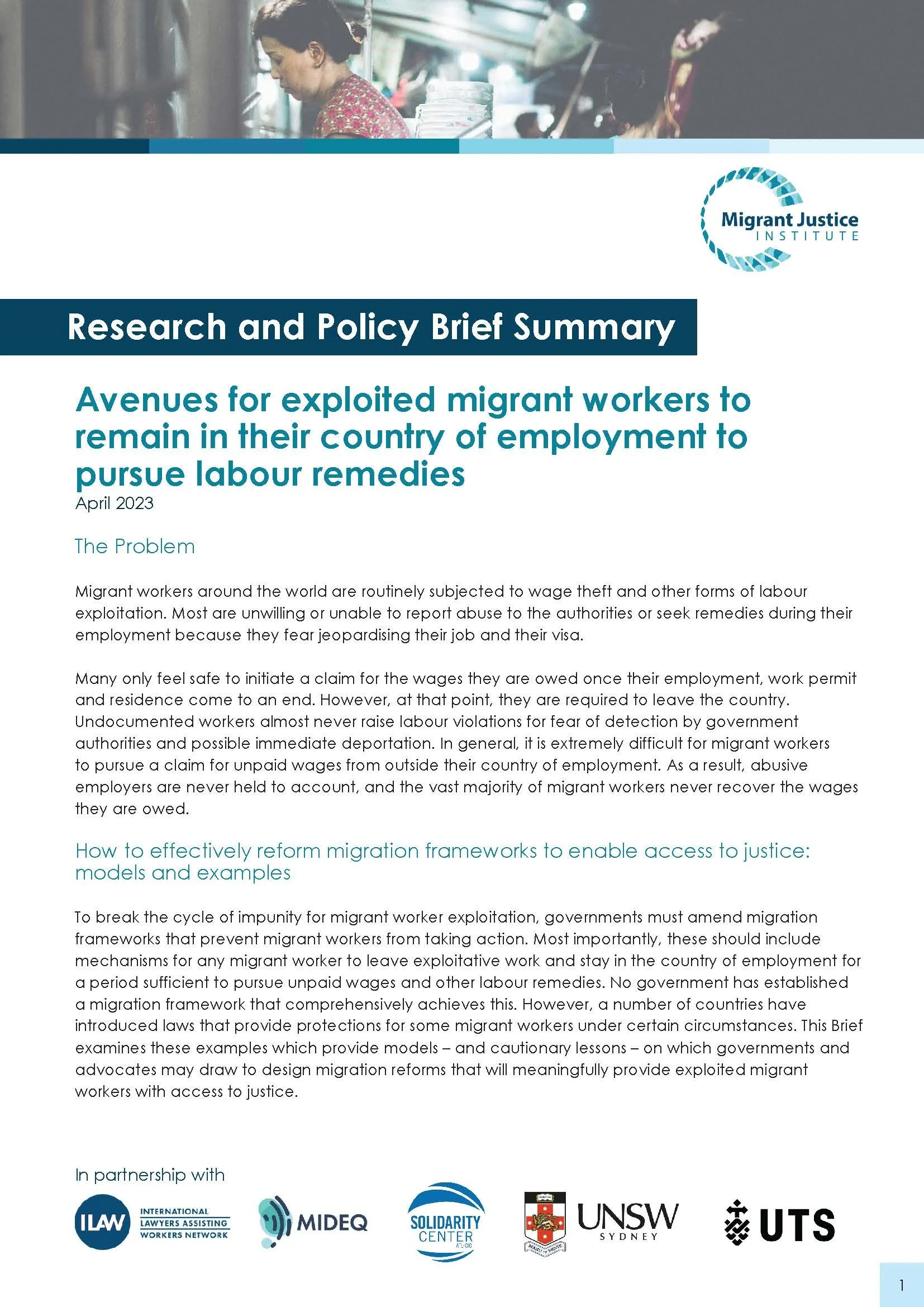
This Research and Policy Brief considers migration frameworks that would enable migrant workers to safely speak up, leave abusive employers without losing their visa, or temporarily remain in their country of employment at the end of their stay in order to recover the wages they are owed and hold abusive employers to account.
The Brief includes current examples of
visa portability for exploited migrant workers to bring claims and find a new sponsor,
short term visas with work rights to pursue wage claims at the end of a migrant worker’s stay,
deferral of removal (with work rights) for undocumented workers who pursue labour claims, and
visas for victims of trafficking and criminal wage theft and exploitation to pursue civil labour claims.
It is accompanied by a more detailed case study of recent advances in the United States which enable migrant workers, including undocumented workers, to remain in the country for up to two years with work rights in order to pursue unpaid wages and other labour claims.

Breaking the Silence: A Proposal for Whistleblower Protections to Enable Migrant Workers to Address Exploitation
Led by the Migrant Justice Institute and Human Rights Law Centre, the Breaking the Silence proposal urges the Federal government to establish whistleblower protections that would enable migrant workers to report exploitation without risking their visa.
Breaking the Silence: A Proposal for Whistleblower Protections to Enable Migrant Workers to Address Exploitation
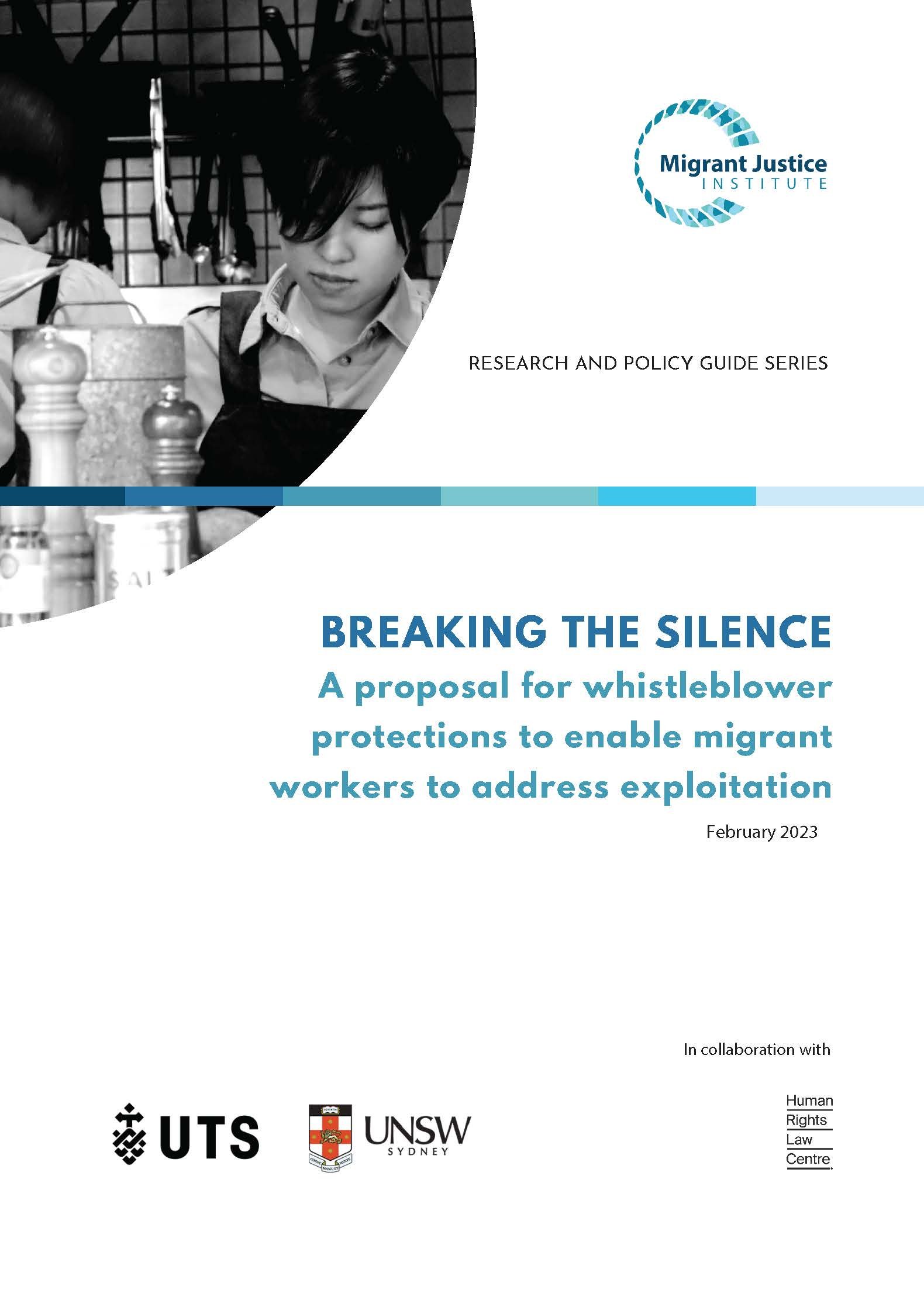
Led by the Migrant Justice Institute and Human Rights Law Centre, the Breaking the Silence proposal urges the Federal government to establish whistleblower protections that would enable migrant workers to report exploitation without risking their visa. The proposal is endorsed by a national coalition of over 40 legal service providers, unions, ethnic community peak bodies, churches, and national organisations.
Migrant workers generally endure exploitation in silence for fear of jeopardising their visa or ability to stay in Australia. The proposed reforms in Breaking the Silence include:
A protection against visa cancellation for exploited migrant workers who take action against their employer and have breached their work conditions;
A short-term visa to allow exploited migrant workers to remain in Australia and pursue a claim against their employers, with visa security and the ability to work.

Migrant Workers' Access to Justice for Wage Theft: A global study of promising initiatives
Bassina Farbenblum and Laurie Berg, Migrant Workers’ Access to Justice for Wage Theft: A Global Study of Promising Initiatives (2021)

Remedies for Migrant Worker Exploitation in Australia: Lessons from the 7-Eleven Wage Repayment Program
(2018) 41(3) Melbourne University Law Review 1035
Article: Laurie Berg and Bassina Farbenblum, “Remedies for Migrant Worker Exploitation in Australia: Lessons from the 7-Eleven Wage Repayment Program” (2018) 41(3) Melbourne University Law Review 1035
Image credit: Arifin Salleh on Unsplash

Migrant workers’ access to remedy for exploitation in Australia: The role of the national Fair Work Ombudsman'
(2017) 23(3) Australian Journal of Human Rights (online first)
Article: Laurie Berg and Bassina Farbenblum, 'Migrant workers’ access to remedy for exploitation in Australia: The role of the national Fair Work Ombudsman' (2017) 23(3) Australian Journal of Human Rights (online first)

Migrant Workers' Access to Justice at Home: Nepal
Report: Sarah Paoletti, Eleanor Taylor-Nicholson, Bandita Sijapati and Bassina Farbenblum, Migrant Workers' Access to Justice at Home: Nepal (Open Society Foundations, 2014)

Migrant Workers' Access to Justice at Home: Indonesia
Report: Bassina Farbenblum, Eleanor Taylor-Nicholson and Sarah Paoletti, Migrant Workers' Access to Justice at Home: Indonesia (Open Society Foundations, 2013)